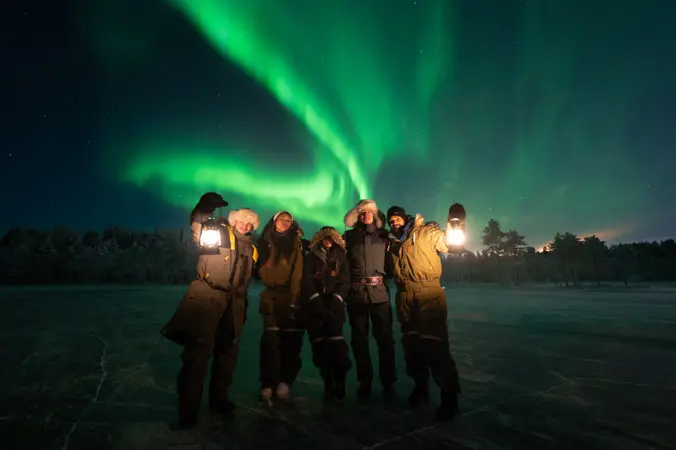
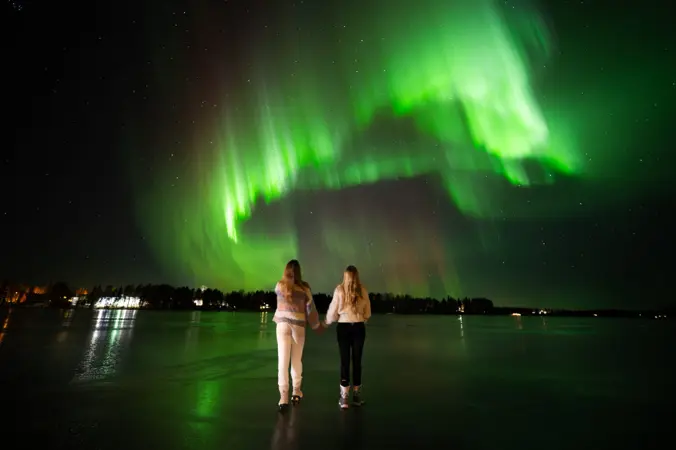
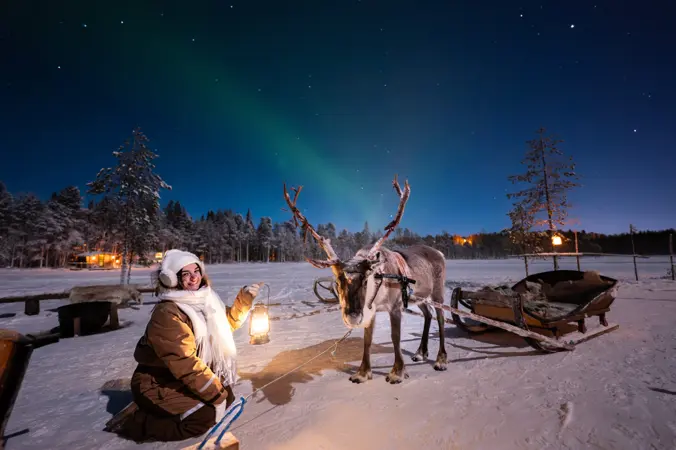
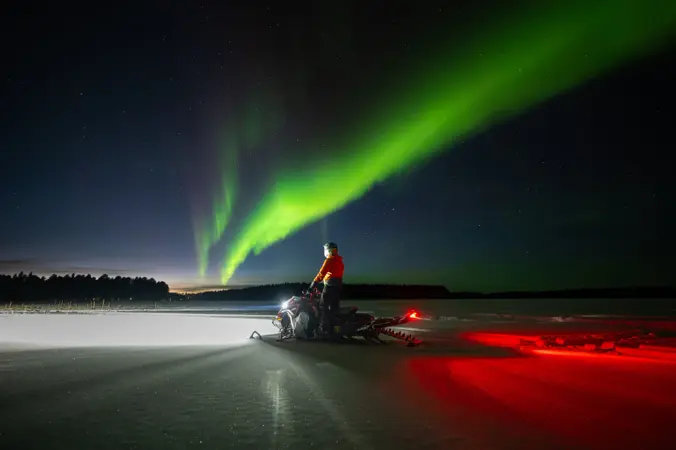
Can you see Northern Lights in Ranua?
Yes. In Ranua’s dark season, Northern Lights are possible when darkness, a clear view through the clouds and aurora activity coincide. This guide helps you choose when to visit, prepare for the evening and compare guided experiences.
Best months for Northern Lights in Ranua
September–October and February–March are useful starting points when choosing your travel dates. In Ranua, Lupland’s standard Northern Lights Hunt lists a season from 1 September to 15 April. Autumn can pair dark evenings with unfrozen lakes; winter adds snowy scenery and winter activities. By spring the nights become shorter. Choose the daytime holiday you want as well as the aurora season: the month alone cannot predict clear skies on your particular night.
What are the best hours?
The Finnish Meteorological Institute gives roughly 21:00–01:00 local time as a favourable window; displays can also occur outside it. Lupland’s 3–4-hour hunt starts at 20:00. Check your tour’s departure and keep the following morning flexible for a 6–8-hour hunt.
Cloud cover: check the view before the aurora forecast
A strong aurora forecast is of little help beneath an unbroken cloud layer. Check cloud cover for the evening and how it may change along the route, alongside space-weather information. A break in the clouds can be more useful than staying at one scenic spot under overcast skies. Forecasts describe possibilities; your guide also watches the actual sky and adjusts the plan when conditions justify it.
Light pollution and choosing a viewing spot
Around Ranua, look for a safely accessible place with an open view of the sky and little direct artificial light. Buildings, headlights and bright lamps can interfere with faint displays and photographs. A forest-edge or lakeshore view may help, provided trees do not block the part of the sky you are watching. Give your eyes time to adapt, dim your screen and keep lamps away from other viewers. Respect private land and use an agreed access point.
Frozen lakes: enjoy the horizon from a safe place
Ranua’s lakes can provide an open horizon and a winter foreground for photographs. You can enjoy that setting from a suitable shore; going onto the ice is not necessary for seeing auroras. Never judge ice safety from snow cover, tracks or a frozen-looking surface. Stay on the agreed route with your guide and confirm any lake access for that particular outing. In autumn, an unfrozen shore offers a different landscape without waiting for snow.
Weather, waiting and what to wear
Cold weather does not create Northern Lights. Temperature and wind matter because you may spend long periods standing still, while clouds affect the view. Wear warm layers, insulated footwear, gloves and a hat, and check which outerwear your chosen tour supplies. Keep batteries warm and allow time for warm-up breaks. A snowy or windy evening may change travel plans even when the space-weather forecast looks promising; follow your guide’s practical instructions.
Photographing Northern Lights in Ranua
Start with a steady tripod and a clear composition: the sky plus a shoreline or forest silhouette can tell the story of the place. On a camera, use a wide lens, focus carefully on a distant star and take a test exposure; shorten the shutter time when the aurora moves quickly. On a phone, try night mode with the device held steady. Review sharpness before taking many frames. The camera may record colour more strongly than your eyes, so photographs are not a promise of the naked-eye view.
Ranua vs Rovaniemi for Northern Lights
Auroras can be seen from both areas when conditions allow. Choose your base around the rest of your holiday, access to dark skies and how you will get back at night. Staying in Ranua works well with local lake experiences and an evening near your accommodation. From Rovaniemi, plan the full return journey or choose a product explicitly including pickup. A town name does not decide visibility: clouds, local lighting and the view from your actual spot matter more on the night.
Why guides sometimes drive elsewhere
The best starting point is not always the best viewing point later that evening. A mobile guide compares cloud patterns and aurora information with travel time, access and the group’s schedule. Lupland’s 6–8-hour Extreme Hunt specifically uses weather and aurora maps to choose a route. Moving makes sense when another area offers a more useful opening in the sky; it does not manufacture auroras. A stationary Activity Park instead provides a complete evening at one site, with viewing when the sky allows.
No guarantees: plan an evening you will enjoy
Neither a longer tour nor several nights in Ranua guarantees a sighting. Choose an evening whose full program you enjoy, whether that includes a campfire, photography or other activities. Check the product for inclusions and booking terms.